
The AI Leverage Audit
A hundred possible AI projects. Two weeks to know which ones pay.
A fixed-scope, fixed-price diagnostic. I interview your leadership, my AI interviews your entire team the same afternoon, and you get the Leverage Map: where AI pays in your business, what each opportunity is worth, and what to build first. You get the full roadmap, and you don’t need me to implement it. It is not a sales call with a costume on.
Net unrefunded fee credited under the 30-day Sprint terms below. 10× Map Guarantee (details below).
Two weeks · Fixed price · 10× guarantee
Why an audit first
The expensive mistake is building the wrong thing.
You’ve seen the demos. You know AI can help somewhere. The hard part is knowing which of the hundred possible projects is worth real money and which one burns three months for nothing. Most owners either guess or stall. The audit exists so you can do neither.
Most AI assessments also stop at half the question: what can we cut? Cost-cutting is real, and it’s usually the smaller half. The bigger half is the work you’re not capturing: the jobs you don’t bid, the inquiries that sit, the clients you turn away. The audit prices both.
What happens
Two weeks. Four steps. One map.
Day one
Step 1: The deep dive (90 minutes).
A working session with you and your leadership. Brain-dump, think out loud, no prep required. I bring the questions, including the ones most owners have never been asked. What winnable work did you miss, decline, or lose last quarter? The jobs you didn’t bid, the inquiries that sat, the work you turned away because you couldn’t take it on. That’s usually where the bigger number lives, and it stays your number, because you’ll do that arithmetic out loud in your own figures. The day you book, the AI Leverage Audit Companion arrives: an optional hour of guided prep. Whatever you fill in becomes my intake before I walk in. Skip it entirely and nothing changes; I bring the questions either way.
Same afternoon
Step 2: Your whole team, interviewed the same afternoon.
This is the part nobody else offers. My AI calls every employee for a short phone interview about their job and where it grinds. Twenty people or two hundred, same afternoon. One question is standard in every interview: if your bottleneck vanished, how much more could your area handle, and what do we currently turn away? Your team hears exactly what the interviews are: a search for friction and untapped capacity. They are not a headcount review, and individual answers are never used to evaluate anyone. Owners consistently tell me they’ve never seen this data about their own company. “18 of my 20 people say we should fix this” is a very different conversation than a hunch.
Before readout
Step 3: Systems and tooling review.
What you run, what your team actually uses, and what your VAs are doing. The VA line item is usually the first savings we find, and it often covers the audit fee by itself.
About two weeks
Step 4: The readout. Your Leverage Map.
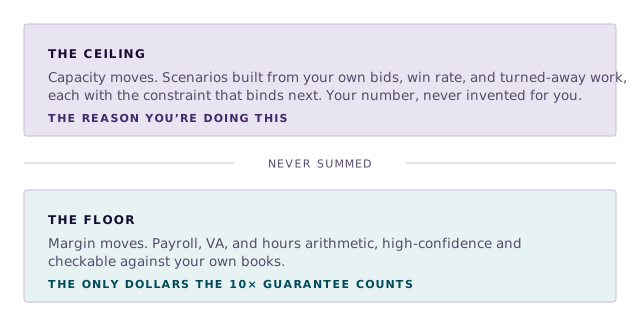
Every opportunity goes on the map in one of two sections, because they’re two different kinds of number and you deserve to know which is which:
- The Floor: savings. Payroll, VA, and hours arithmetic you can check against your own books.
- The Ceiling: new revenue. What AI would let you go get that you can’t today, in scenarios built entirely from your own inputs (your bids per week, your win rate, your turned-away work). Each scenario names the thing that would limit it next, whether that’s crews, working capital, or demand.
The Map also records the Day-One Baseline: your bids per week, win rate, cycle time, declined work, and capacity utilization, as you attest them today. That way, a year from now, “did it work?” is arithmetic instead of argument. Every opportunity carries a durability judgment (a compounding asset, a head start, or a defensive necessity), a recommended build order, and tool recommendations from someone who doesn’t take vendor commissions. The readout ends with the build sequence and your first Leverage Library assignments, so you walk out knowing exactly what to do first and in what order.
What you walk away with
- The Leverage Map. The Floor (savings you can check) and the Ceiling (new revenue scenarios in your own numbers, with the limits named), ranked and sequenced. Yours to keep and act on with anyone, including nobody.
- The Day-One Baseline. Where your business actually stands today (bids, win rate, cycle time, turned-away work), so a year from now “did it work?” is arithmetic instead of argument.
- The workforce-interview report. What your team actually said about where the friction is and what they could handle if it were gone.
- Access to the Leverage Library. The member toolkit that comes with every engagement: the First Five Hours path, The $20-an-Hour Task Audit, one path matched to your Map, and the Audit Companion that arrives the day you book.
- A live demonstration. The AI that just interviewed your whole team is the same kind of system I’d help you build. There’s no better test drive.
Pricing
Fixed price. Eligible for Sprint credit.
Fee schedule
effective July 2026 · all figures USD
| Company size | Price |
|---|---|
| Up to 25 employees | $2,500 |
| 26 to 50 employees | $3,500 |
Above 50 employees the Audit is out of scope as priced; start a conversation and we’ll scope it properly.
The net unrefunded Audit fee credits toward the Sprint when you sign the Sprint agreement and pay its first invoice or pay-in-full balance, after the credit, within 30 days of your readout. Booking kickoff alone does not qualify. A refunded Audit fee is unavailable as credit. Walk away and you still own the map.
If you arrived through the AI Leverage X-Ray, that payment applies first to this Audit fee; the total Sprint credit is still the canonical Audit fee, not the two prices added together.
The 10× Map Guarantee
If the Leverage Map doesn’t identify at least ten times your audit fee in annual savings and new revenue opportunities, I refund the whole fee and you keep the map anyway. The guarantee’s defined terms are in the engagement agreement.
Objections
“Why isn’t this free? Everyone offers a free AI assessment.”
Because a free assessment is a sales call, and everybody knows it. This is a real diagnostic with real deliverables, priced so I can do it properly. And the net unrefunded fee credits to the Sprint when its agreement is signed and its first invoice or pay-in-full balance is paid within 30 days of readout.
“Can’t my team figure this out themselves?”
Probably, eventually. Budget the five-hour learning hump per person, plus the odds of building the wrong thing first. What you’re buying is a shortcut past the expensive part, drawn by someone who does this every week.
“Can’t I just hire an AI person?”
You can try. Good ones are scarce, expensive, and mostly getting hired by companies much bigger than yours. A full-time salary is also hard to justify when what you actually need is the diagnosis, the build plan, and someone accountable for shipping. If your Map says you genuinely need the hire, it will say so, and you’ll be hiring with a plan instead of a hope.
“Are you promising growth?”
No, and be suspicious of anyone who does. AI can capture demand you can already see being missed: the jobs you didn’t bid, the inquiries that sat, the work you turned away. It does not manufacture customers; selling that is the agency business, and you may have paid that tuition already. Every growth figure on your Leverage Map is built from your own inputs, with the assumptions written down and the limits named. One more piece of candor: I don’t have a published growth case study yet. The first one is in the ground now and lands this fall.
“Is this a pitch for software you resell?”
No. I resell nothing and take no commissions. Part of the map’s job is telling you what not to buy.
“What do you do with our data?”
Interview transcripts and systems information stay confidential and are used only to produce your deliverables, under an agreement we sign before anything begins. If you’re in a regulated business, I’ll walk through your compliance questions before the audit starts.
The map is two weeks away.
Book the audit and the leadership deep dive goes on my calendar this week.
Questions first? Start a conversation